

Start from Daily Habits: TCM Eye Care to Prevent Myopia Progression
15/07/2026
Women's Health | Start from Daily Habits: TCM Eye Care to Prevent Myopia Progression
.png)
林晨欣中医师
Ms Lim Chen Sing
TCM Senior Practitioner (Paediatric)
TCM Practitioner's Advice:
"Mom, I can't see the blackboard clearly." When your child's myopia worsens, don't just rush to change their glasses.
TCM believes that caring for the eyes begins with nurturing the body. Deficiencies in the Spleen, Liver, and Kidneys all impact eyesight.
Utilizing acupoint massage and Chrysanthemum Goji tea, paired with the 20-20-20 rule, can effectively help delay vision deterioration.
"Mom, the words on the whiteboard look so blurry!" This phrase is becoming increasingly common in classrooms.
With the widespread use of electronic products, children spend much more time on close-up visual tasks, causing symptoms like blurred vision and eyestrain to appear at a younger age.
Consequently, many young children are starting to wear prescription glasses early. The eyes are not just the windows to the soul; they are a child's vital tool for learning about the world.
Therefore, pediatric eye care should be implemented proactively from a young age rather than waiting until vision declines.
Myopia from Western and TCM Perspectives
- Modern Medicine (Western View):
Pediatric vision problems are primarily linked to prolonged close-up eye use, poor posture, inadequate lighting, and excessive screen time. When the eyes focus on near objects for long periods, the ciliary muscles remain continuously contracted. Without proper rest, this causes visual fatigue and increases the risk of myopia progression.
- TCM Perspective:
TCM states that "the essence of all five organs and six viscera flows upward to nourish the eyes." The eyes are intimately linked to the functions of the Liver, Spleen, and Kidneys. If a child regularly stays up late, overuses their eyes, or maintains an unbalanced diet, it can lead to a deficiency of Qi and Blood or loss of nourishment from the Liver and Kidneys. This deprives the eyes of essential moisture, resulting in dry eyes, visual fatigue, and blurry vision.
TCM Constitutional Care to Support Vision
Therefore, TCM eye care focuses on overall body constitution alignment and easing visual fatigue, rather than merely addressing localized eye symptoms. TCM emphasizes differentiating a child's constitution to relieve strain:
- Children with Liver and Kidney Deficiencies: Often present with dry eyes, easy fatigue, and poor night vision. TCM treatments aim to nourish the Liver and Kidneys and replenish vital essence and blood.
- Children with High Stress or Restless Sleep: Treatments are combined with calming, mind-soothing herbs.
- Children with Spleen Deficiencies or Qi/Blood Shortages: Focus is placed on strengthening the Spleen and boosting Qi to enhance the body's digestive and metabolic production of blood.
Gentle Reminder:
It is important to note that TCM therapies primarily serve as supportive healthcare to relieve eyestrain and optimize physical health. They cannot reverse established true myopia. Regular professional eye refractions and vision checks remain essential.
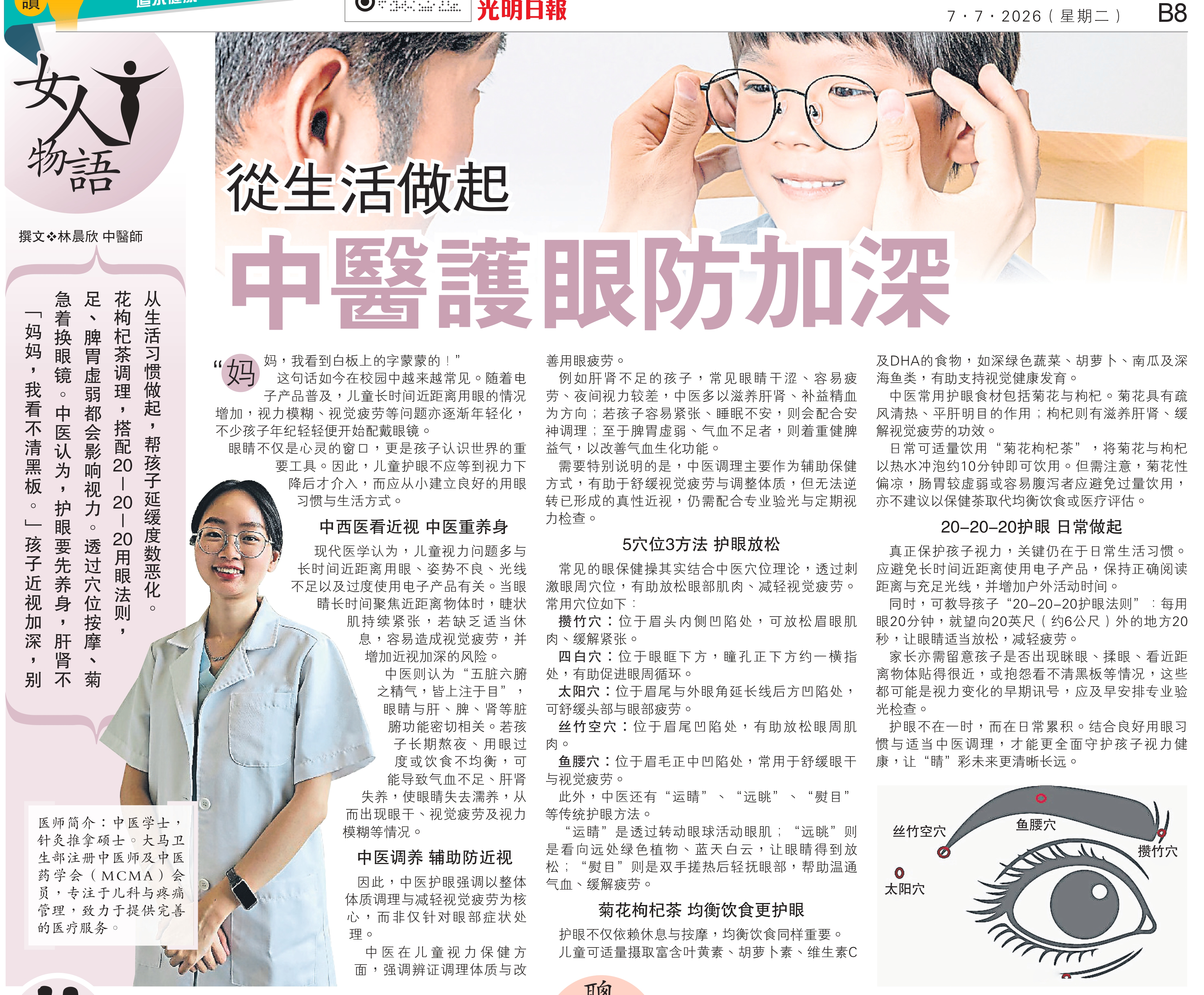
Acupoints & 3 Methods for Eye Relaxation
Common eye exercises are rooted in TCM acupoint theory. Stimulating the acupoints around the eyes helps relax ocular muscles and relieve eyestrain.
The frequently used acupoints include (refer to the diagram for visual locations):

Additionally, TCM utilizes three traditional techniques:
"Eye Rolling" (運目), "Distant Gazing" (遠眺), and "Eye Palming" (熨目):
- Eye Rolling: Rotating the eyeballs to exercise the eye muscles.
- Distant Gazing: Looking at distant green plants or the blue sky to allow the ciliary muscles to relax.
- Eye Palming: Rubbing the hands together until warm and gently placing them over the eyes to warm the Qi, activate blood flow, and soothe fatigue.
Chrysanthemum Goji Tea & Balanced Diets
Eye protection depends heavily on a balanced diet alongside proper rest. Children should be encouraged to consume foods rich in lutein, beta-carotene, Vitamin C, and DHA—such as deep leafy greens, carrots, pumpkins, and deep-sea fish—to support healthy visual development.
Classic TCM eye-care ingredients include Chrysanthemum and Goji Berries. Chrysanthemum helps dispel heat, soothe the liver, and brighten vision, while Goji berries nourish the Liver and Kidneys to alleviate eye fatigue. A simple "Chrysanthemum Goji Tea" can be made daily by steeping the ingredients in hot water for about 10 minutes. Note: Since chrysanthemum has a cooling nature, children with weak digestion or those prone to diarrhea should avoid drinking it excessively. Herbal teas should never replace a balanced diet or formal medical evaluation.
The 20-20-20 Rule for Daily Habits
Protecting a child's eyesight relies fundamentally on daily living habits. Avoid prolonged close-up electronic screen use, maintain a proper reading distance with ample lighting, and increase outdoor activities.
Teach children the "20-20-20 Eye Care Rule":
Every 20 minutes of close-up work, look at something 20 feet (approx. 6 meters) away for at least 20 seconds to allow the eyes to relax and recover from fatigue.
Parents should stay alert for early signs of vision changes, such as squinting, rubbing eyes, holding objects unusually close, or complaining about a blurry blackboard. Early professional vision testing is key. Eye protection is a long-term commitment built on daily diligence. Combining healthy habits with proper TCM care provides the best shield for your child's eyes, ensuring a bright, clear future.
(Article by TCM Practitioner, Ms. Lim Chen Sing)