

The Utmost Danger of Femoral Neck Fractures — Early Prevention for a Safe and Healthy Golden Age
21/03/2026
Medical Insights: The Utmost Danger of Femoral Neck Fractures — Early Prevention for a Safe and Healthy Golden Age
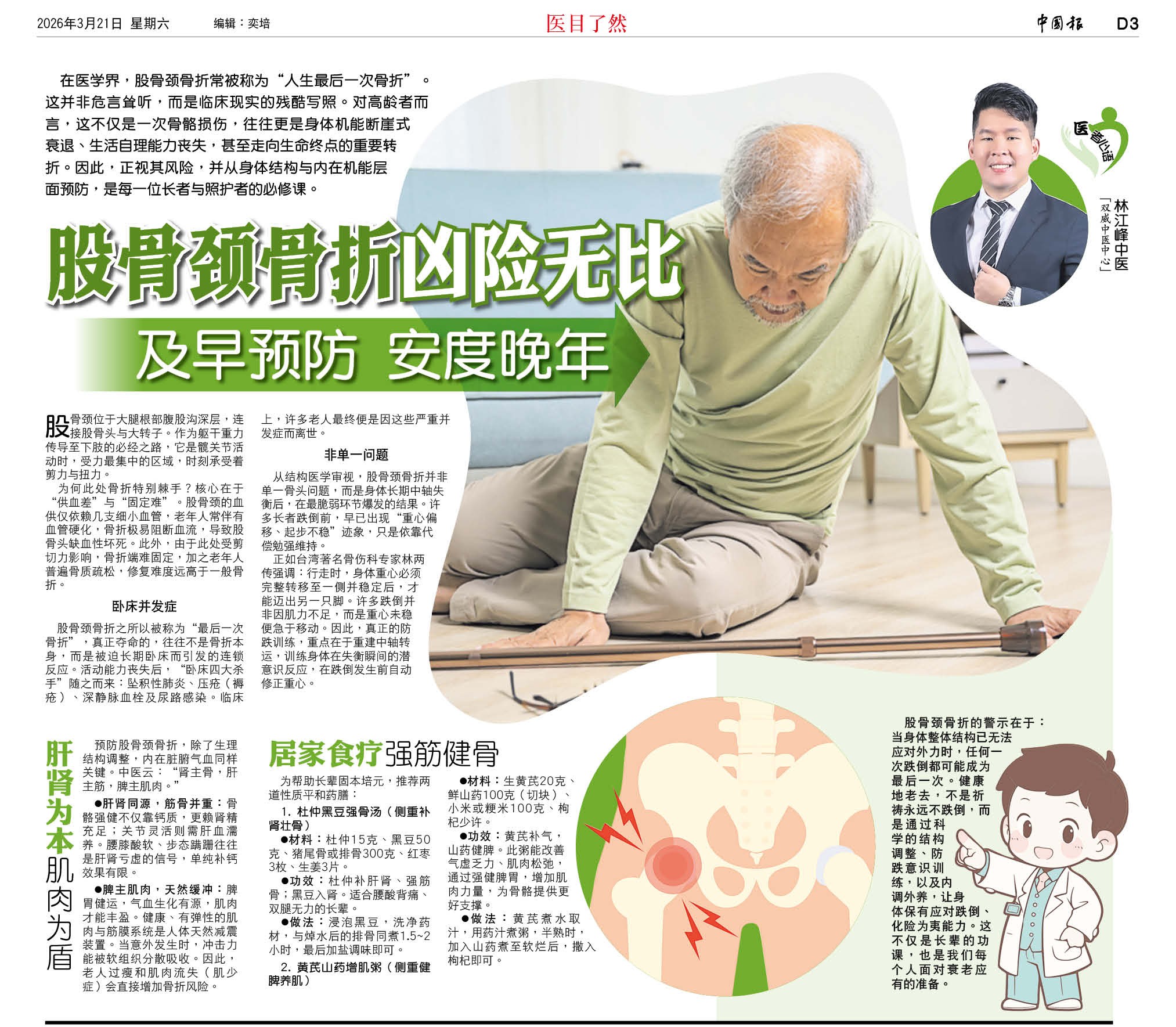
In the medical community, a femoral neck fracture is frequently referred to as "the last fracture of a lifetime." Far from being alarmist, this phrase represents a brutal clinical reality.
For the elderly, it is not merely a localized bone injury; it is often a critical turning point that triggers a precipitous decline in bodily functions, a total loss of self-care independence, and even a trajectory toward the end of life.
Therefore, understanding its risks and comprehensively preventing it through both structural and internal physiological approaches is a mandatory lesson for every older adult and caregiver.
Why Are Femoral Neck Fractures So Intractable?
The femoral neck is deeply located at the root of the thigh within the groin area, connecting the femoral head to the greater trochanter. As the mandatory pathway for transferring weight from the torso to the lower limbs, it is the area that experiences the highest concentration of stress during hip joint movement, constantly enduring shearing and twisting forces.
Why is healing particularly difficult here? The core issues lie in "poor blood supply" and "difficulty in fixation."
- Poor Blood Supply: The blood supply to the femoral neck relies on only a few tiny blood vessels. Since elderly individuals often suffer from arteriosclerosis, a fracture can easily disrupt this blood flow, leading to avascular necrosis of the femoral head.
- Difficulty in Fixation: Due to the severe shearing forces acting on this area, stabilizing the fractured ends is immensely difficult. Compounded by the prevalence of osteoporosis in older adults, the recovery difficulty is exponentially higher than that of a standard bone fracture.
The Real Silent Killers: Bedridden Complications
The primary reason a femoral neck fracture is called "the last fracture" is that the true cause of mortality is rarely the bone break itself. Instead, it is the domino effect triggered by forced, long-term bed rest. Once mobility is completely lost, "the four clinical killers" quickly emerge:
- Hypostatic Pneumonia
- Bedsores (Pressure Ulcers)
- Deep Vein Thrombosis (DVT)
- Urinary Tract Infections (UTIs)
In clinical settings, a vast majority of seniors ultimately pass away due to these severe, secondary bedridden complications.
Not Just a Single Bone Issue: A Structural Medicine Perspective on Falls
From the viewpoint of structural medicine, a femoral neck fracture is not an isolated bone problem. Rather, it is the ultimate collapse at the body's weakest link after a prolonged structural imbalance along the central axis.
Many seniors exhibit warning signs such as a "shifted center of gravity or an unstable initial step" long before a fall, barely maintaining their upright posture through bodily compensation.
When walking, the body's center of gravity must completely transfer to one side and stabilize before the other foot can step forward. Many falls do not happen solely because of insufficient muscle strength, but because the center of gravity fails to shift dynamically.
Thus, effective fall-prevention training must focus on rebuilding central axis alignment. This trains the body's subconscious reflexes to automatically correct its center of gravity the split second an imbalance occurs, preventing a fall before it happens.
Internal Regulation: Kidneys as the Root, Muscles as the Shield
To prevent femoral neck fractures, structural realignments must be paired with internal care for the organs, Qi, and blood. As Traditional Chinese Medicine (TCM) states: "The Kidneys govern the bones, the Liver governs the tendons, and the Spleen governs the muscles."
- Shared Source of Liver & Kidneys: Strong bones rely on more than just calcium; they require abundant Kidney Essence. Likewise, hip joint flexibility requires nourishment from Liver Blood. Weakness in the lower back and knees, or a shuffling gait, are common signals of Liver and Kidney deficiencies—situations where simple calcium supplementation yields limited results.
- The Spleen Regulates Muscles as a Natural Buffer: When the Spleen and Stomach function efficiently, Qi and blood have an abundant source, allowing muscles to remain plump and strong. Healthy, elastic muscle and fascial systems act as the body's "natural shock absorbers." When an accident occurs, the impact force can be dispersed and absorbed by these soft tissues. Consequently, extreme thinness and age-related muscle wasting (sarcopenia) directly increase the risk of a fracture.
Home Dietary Therapy: Recommended Bone & Muscle Strengthening Recipes
To help older adults cultivate their root vitality, here are two gentle, well-balanced therapeutic recipes:
- Ingredients: Eucommia bark (杜仲) 15g, black beans 50g, pork tail bone or ribs 300g, 3 red dates, 3 slices of fresh ginger.
- Benefits: Strengthens bones, nourishes the Liver and Kidneys, and reinforces tendons. Black beans directly target the Kidneys, making this ideal for seniors dealing with chronic lower back pain and knee weakness.
- Preparation: Soak the black beans in advance and rinse the herbs. Combine them with blanched pork ribs and simmer together for 1.5 to 2 hours. Season with a pinch of salt to finish.
- Ingredients: Raw Astragalus root (生黃芪) 20g, fresh Chinese yam (鮮山藥) 100g (cubed), millet or indica rice 100g, a small handful of goji berries.
- Benefits: Astragalus replenishes Qi, while Chinese yam strengthens the Spleen. This congee targets Qi deficiency, fatigue, and muscle flaccidity. By toning the Spleen and Stomach, it builds muscle strength to provide optimal structural support for the skeleton.
- Preparation: Boil the Astragalus in water first and strain to collect the medicinal broth. Use this broth to cook the rice into congee. When the congee is halfway cooked, add the fresh Chinese yam cubes and simmer until soft and creamy. Garnish with goji berries before serving.
Practitioner's Insight
The stark warning of a femoral neck fracture is this: when the body's overall structural integration can no longer withstand external forces, any single fall could become the final one.
Aging healthily does not mean idly praying that we never stumble. Instead, it means utilizing scientific structural adjustments, proactive fall-awareness training, and balanced internal/external nourishment to ensure the body retains the resilience to navigate a fall and safely diffuse the danger.
This is not just a lesson for our elders; it is a vital preparation for every one of us as we face the reality of aging.
(Article by TCM Senior Practitioner, Mr. Norman Lim Chiang Feng)